
Concept and Technology
The three-step value chain
Step 1: Green methanol synthesis
Renewable energy, captured CO₂ and green hydrogen are combined to produce green methanol value chain . This is the feedstock for the entire value chain. The methanol synthesis step is well-aligned with commercially proven technology (TRL 8–9 at industrial scale).
Methanol is decomposed into syngas, a mixture of carbon monoxide and hydrogen, using renewable heat. This endothermic reaction simultaneously stores renewable energy as thermochemical heat. The stored syngas can be held until needed, decoupling fuel production from wind and solar intermittency.
Step 3a: Syngas-to-methane (TCES discharge)
Through methanation, syngas is converted to synthetic natural gas, releasing high-temperature heat. The produced methane can be used in existing natural gas infrastructure or injected into the gas grid.
Alternatively, syngas is converted to dimethyl ether (DME), a clean-burning renewable diesel alternative suitable for transport. The two-step route via syngas provides operational flexibility compared to direct methanol-to-DME synthesis.
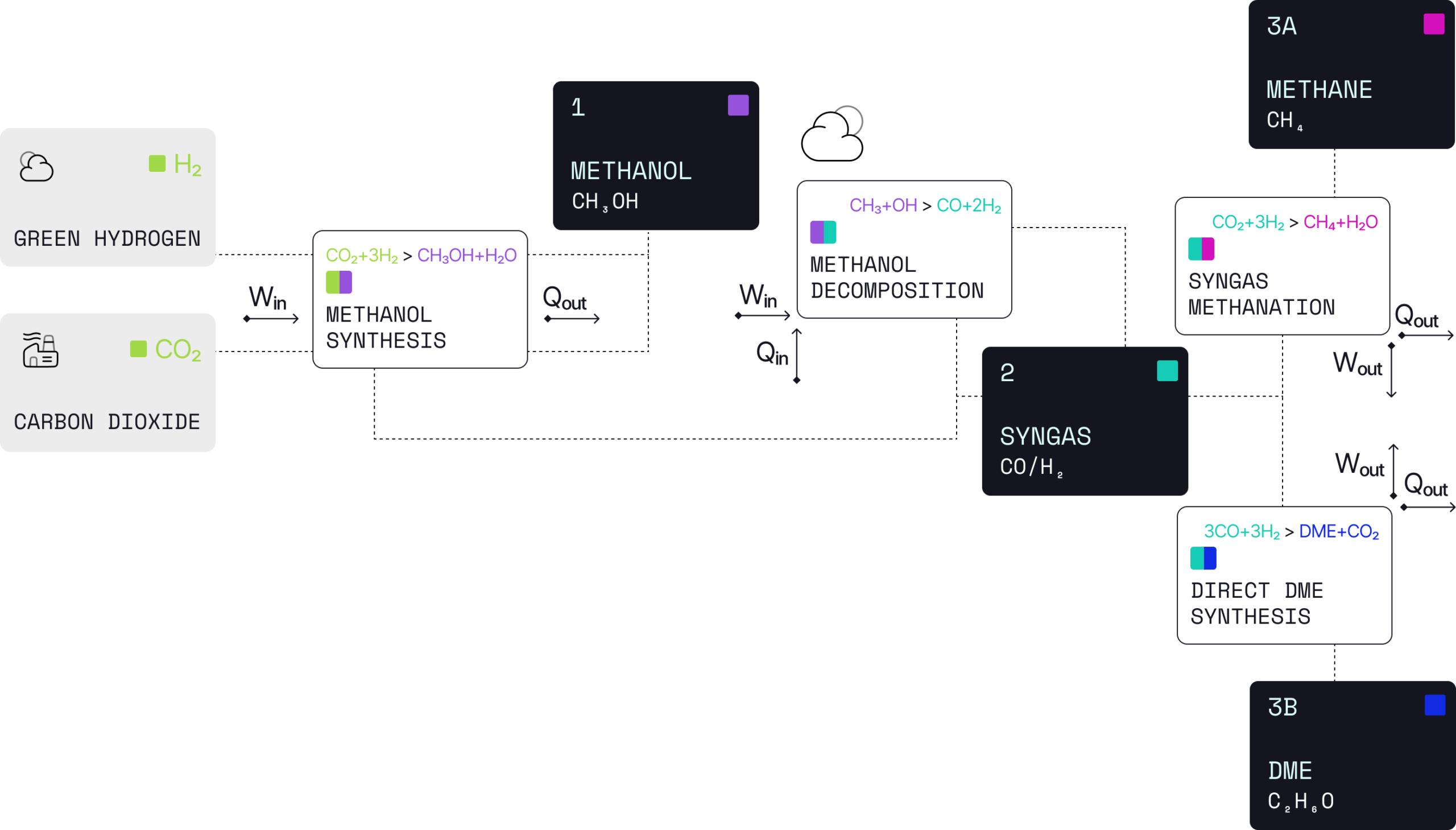
The combination of Steps 2 and 3 creates a thermochemical energy storage system.
Methanol decomposition (Step 2) acts as the charging phase, while syngas-to-fuel conversion (Step 3) acts as discharge, releasing heat and power that can serve industrial consumers alongside fuel production. This TCES approach enables continuous fuel production even when renewable energy supply is intermittent.
Challenges

Behind the promise of METHCESFUEL lies a set of complex, real-world constraints. Overcoming these challenges will determine its path from concept to scalable solution.
Closing the efficiency gap
Catalyst and reactor durability
Economic competitiveness
TRL roadmap
Phase 1
Phase 2
Phase 3
Expected impact
By bridging innovation and application, METHCESFUEL is positioned to create lasting impact across science, industry, society, and the environment.
Scientific

Demonstration of an integrated three-step fuel production value chain with TCES. Global advancement of knowledge on methanol-based processes.
Technological / Economic

Cost-competitive high-yield synthetic renewable fuels. New partnerships, products and services. Triggering of new investments. Contribution to energy security.
Societal

Evidence-based policymaking through communication activities. Support of legislative decision-making. Workforce skills development through training programmes.
Environmental

Green fuels with GHG emissions below 30% of fossil equivalents. CO₂ capture and utilisation integration. Closed-loop carbon-neutral fuel system.
Get in touch •
Renewable methanol-based synthetic multifuel production.

Views and opinions expressed are however those of the author(s) only and do not necessarily reflect those of the European Union or CINEA. Neither the European Union nor the granting authority can be held responsible for them.”
Grant Agreement No. 101235215 | HORIZON-CL5-2024-D3-02
General enquiries: info@methcesfuel.eu
Media enquiries: press@methcesfuel.eu
Partnership and industry board: industry@methcesfuel.eu
Legal Notice | Privacy Policy | Cookie Policy